Study Guide for Chapter Fifteen
A note on Chapter 14:
I'm not sure why Powell put the birth of Heracles into the chapter before the chapter
about Heracles, but mythographers move in mysterious ways. I guess he was hoping to
emphasize the fact that Heracles was descended from another hero who enjoyed divine favor,
Perseus. Heracles, however, had a much more spotty career than Perseus, whose hero story
followed a much more traditional course. "Though destined to become a god," Powell remarks
on page 394, "Heracles was not to be king of Mycenae or Tiryns, but became the slave of
his abject cousin Euystheus." The cause was, of course, Hera's wrath.
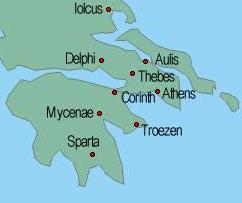 Thebes, by the way, is very far from Mycenae and Tiryns, so Heracles didn't even grow up in the region
where he was supposed to be king. While Thebes isn't nearly as far north as Iolcus--Jason
really was from the boonies, for all he boasted to Medea about how he was a native-born Greek!--it's a long way from the Peloponnesus, as you can see by the map. Yet six of Heracles'
famous labors were to take place in the Peloponnesian region: the lion of Nemea, the
hydra of Lerna, the boar of Erymanthus, the hind of Ceryneia, the birds of Stymphalus, and
the cleansing of the stables of Augeas at Elis.
Thebes, by the way, is very far from Mycenae and Tiryns, so Heracles didn't even grow up in the region
where he was supposed to be king. While Thebes isn't nearly as far north as Iolcus--Jason
really was from the boonies, for all he boasted to Medea about how he was a native-born Greek!--it's a long way from the Peloponnesus, as you can see by the map. Yet six of Heracles'
famous labors were to take place in the Peloponnesian region: the lion of Nemea, the
hydra of Lerna, the boar of Erymanthus, the hind of Ceryneia, the birds of Stymphalus, and
the cleansing of the stables of Augeas at Elis.
If Zeus wanted to avoid Hera's wrath in the first place, one might ask, then why on Earth
did he start boasting to her about how powerful his new son was going to be? Anybody could
have predicted the results. Perhaps he felt that since the promises of the gods cannot be
taken back--and he had, indeed, promised that the boy born that day would be a powerful
king--Hera couldn't do a thing about it. He seems to have forgotten that Hera has a powerful
ally herself, in the form of her daughter Eileithyia. Despite the servant girl Galanthis's
clever trick, Heracles wasn't born on the day Zeus had planned. Or the next day, or the
next...
Poor Alcmena! Here she is, one of the most faithful wives in mythology, and she's persecuted
by the goddess who's supposed to be the protectress of faithful wives. This unfairness is just
the beginning of a long string of unfair circumstances that will dog Heracles until his death.
This unfairness on the part of the gods is very typical of the Mesopotamian tradition, where
the gods tend to be completely callous about human beings and to see them merely as potential
servants. In this way, the connection with The Epic of Gilgamesh and other Mesopotamian
tales, which Powell emphasizes on pages 428-434, is extremely close. It's probably an indication
that the Heracles stories are among the oldest in the Greek mythological tradition.
Remnants of the Heracles Myth
As Powell points out at the beginning of Chapter 15, we have no central mythological account of
Heracles so we have to put together his story from bits and pieces. As a result, it sometimes
seems rather fragmented. Even Heracles himself seems fragmented: sometimes he's a buffoon who
doesn't know his own strength, while other times he's a high-souled tragic hero. Powell
quotes from Euripides' Heracles,
but in the midst of that tragic scene he comes off with little dignity.
Interesting, isn't it, that the gods permit him to slay his own wife and children, but Athena
breaks in and stops him as soon as he comes after his father? She really is a Daddy's Girl,
isn't she?
Incidentally, Megara's father, Creon, is not the same Creon as Glauke's father in Medea
or Antigone's uncle in Antigone (we haven't read the story of Antigone yet, but we will
next month). The name "Creon" is a sort of generic term for "king." Glauke's father is the
King of Corinth and both Megara's father and Antigone's uncle are kings of Thebes--but not the
same king.
Notice that Powell mentions the Athenian massacre of the Melians as a possible inspiration for
Euripides' subject. That's the same massacre I mentioned in my post regarding the Week Seven
Discussion Topic. It seems to have inspired several of Euripides' accounts of the ancient
myths--it must have made a very deep impression on him.
The Twelve Labors
Nobody I know can keep the twelve labors straight, so don't worry about it. The important thing
to remember is that there were twelve of them, and that the first one was the Nemean lion.
The lion is particularly important because Heracles is usually depicted wearing its skin, so the
lion skin and his handy club are the easiest way to identify Heracles in ancient art.
Along with the Nemean lion, the most famous labors are the Lernaean hydra, the Augean
stables (which have found their way into our culture's store of metaphors as a way of
referring to a seemingly impossible task, such as trying to sort all the papers in my office),
the apples of the Hesperides, and the theft of Cerberus.
Apart from those four,
the "side deeds"--Chiron's encounter with Heracles' poisoned arrow, Heracles' rescue of Alcestis
from the underworld and Prometheus from the Caucasus, and the encounter with Atlas--are far
better known than the labors themselves.
 | Surprise!
|
The famous classicist Michael Grant suggests in his Myths of the Greeks and Romans
(Harcourt, Brace 1962) that the Cerberus labor was saved for last because it was the hardest of
Heracles' assignments, the one from which it could be almost certain he would not come back.
And indeed, when you read Wednesday's assignment you'll see just how few people ever did visit
the underworld and live to tell about it. Imagine Eurystheus's surprise!
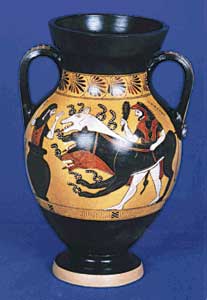
Most accounts of this particular story describe Eurystheus as being so terrified when he heard
Heracles had returned and wanted to show him what he'd caught, he hid in a large oil jar and
hoped that Heracles would just go away. But Heracles was persistent.
Grant groups the Cerberus story together with the
rescue of Alcestis, and quotes Richmond Lattimore's translation of lines 28-35 of Pindar's Olympian
IX (not Nemean I, which Powell quotes at the beginning of Chapter 15--a poet like Pindar,
with his fascination with athletic prowess, was naturally drawn to Heracles as a subject and
sang about him more than once) as proof of how this deed, along with other encounters with the
gods, showed that Heracles "partook of divinity":
If men are brave, or wise, it is by the divinity
in them. How else could Heracles'
hands have shaken the club against the trident,
When by Pylos' gate Poseidon stood over against him,
and Phoebus strode on him with the silver bow in his hands poised?
neither the death-god Hades rested the staff
wherewith he marshals mortal bodies, of men perished, down the hollow street.
Grant also suggests that Heracles' adventures with Cerberus and Alcestis, differing from the
tale of Gilgamesh in that Heracles was actually successful in his quest, might be one of the
major sources of the Christian tradition of "the harrowing of Hell," which claims that the
reason Christ took three days between his crucifixion and resurrection is he was busy retrieving
all the Old Testament patriarchs and matriarchs from the underworld so he could bring them to
Heaven.
As Powell explains on page 427, "other heroes challenge Death...but none so often or explicitly
as Heracles."
After the Labors
The servitude to Omphalê is not always depicted in as light-hearted a tone as Powell uses
on page 419. Frequently it is shown as downright humiliating, contributing to the anger that
led Heracles to gather his army. In our text's account, Heracles marched on King Laomedon of Troy
(Poseidon finally got his revenge over that refusal to pay for the walls!) and Laomedon's son
Priam was set up as the new king. This makes sense in light of standard chronology. Generally
the Argonauts, who included Heracles among their crew, are portrayed as being one generation older than the warriors who fought in the Trojan War.
What is not standard chronology, because there isn't one, is the point in Heracles' career in which he is slave to
Omphalê. Because his myth is a bit fragmented, the order in which events happened is
sometimes mixed up and there are alternative accounts. According to Sophocles' Women of
Trachis, for instance, Heracles had been married
to Deianeira for several years before he was forced into Omphalê's service. The play
begins with Deianeira waiting for him to return home. Before Heracles arrives, a herald shows
up and explains
that he has just won a great victory:
The greater part of the time he was detained in Lydia, no free man, as he declares, but sold into servitude. No offense should be taken at my tale, lady, when the deed is found to be Zeus' work. He passed a whole year, as he himself says, a bought slave to the barbarian Omphale. And so stung was he by the shame of it, that he bound himself by a solemn oath, swearing one day to enslave with wife and child the man who had brought that suffering upon him. And not in vain did he speak the oath; but, when he had been purified, he gathered a mercenary army and went against the city of Eurytus. (lines 248-261)
What the herald doesn't mention, however, is that during what Powell calls his "Lydian period"
Heracles met and fell for Eurytus's daughter Iolê, who has now become his lover. In
Sophocles' version, the war is not against Troy but against Iolê's home city of Oechalia. Heracles is now returning to establish his new mistress as part of the household, which is why
Deianeira will eventually resort to the deadly "love potion."
Apotheosis
In the end, Heracles' divine nature kicks in and he becomes a god, ascending to Olympus while
still in his body. His reward for all his suffering is... to become Hera's son-in-law. For
all eternity. Surely there's a certain irony in that?
As a god, Heracles was worshipped and had his own cults, sometimes with rather bizarre results.
If you saw the movie Gladiator, you'll remember the slimy Caesar Commodus, who persecutes
the hero as mercilessly as Hera ever persecuted Heracles. The movie isn't based on actual
history (sorry!), but Commodus was a real emperor and was every bit as bad as the movie made out.
Maybe worse. Toward the end of his life, shortly before he was murdered by his own guards, he
began calling himself "the reincarnation of Hercules." It was traditional for a Caesar to go through
apotheosis and become a god after death (the last words of Caesar Vespasian, who died in 79
A.D., are said to have been "I think I'm becoming a god"), but not
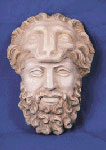
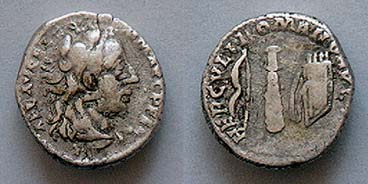
while one was still alive. It was in bad taste. Yet Commodus had himself portrayed as Hercules,
with his own wimpy face peeking out from under the Nemean lion's skin, in a famous portrait bust and on the Roman
coins. In the example below, a Denarius struck in 191 or 192 A.D., he
has put himself on the front and various objects associated with Hercules--the ever-present
club, plus a bow and a quiver of arrows--on the back. If you squint just right you can read
the name "Hercules" along the rim on the left-hand side.
Speaking of movies, if you've seen Disney's Hercules you'll probably have noticed how
oddly the stories have been changed. For instance, he saves his first wife, Megara (not
Deianeira), from the lustful centaur. The Disney film also includes the Alcestis/Cerberus
descent-to-the-underworld theme. And, of course, Philoctetes' role, not to mention his
species, is completely different. For a detailed comparison, see the Disney's Hercules page at
Carlos Parada's Greek Mythology Link.
Gilgamesh
The section on The Epic of Gilgamesh is pretty straightforward and gives good coverage
of the epic except for the portion about the flood, which has no parallel in the Heracles myth
and thus gets glossed over rather quickly. Nevertheless, the flood account in Gilgamesh
makes for an interesting comparison with the story of Deucalion and Pyrrha, and shows even closer
parallels to the Biblical story of Noah. I highly recommend this page, which
gives the entire account along with a little bit of useful commentary.